
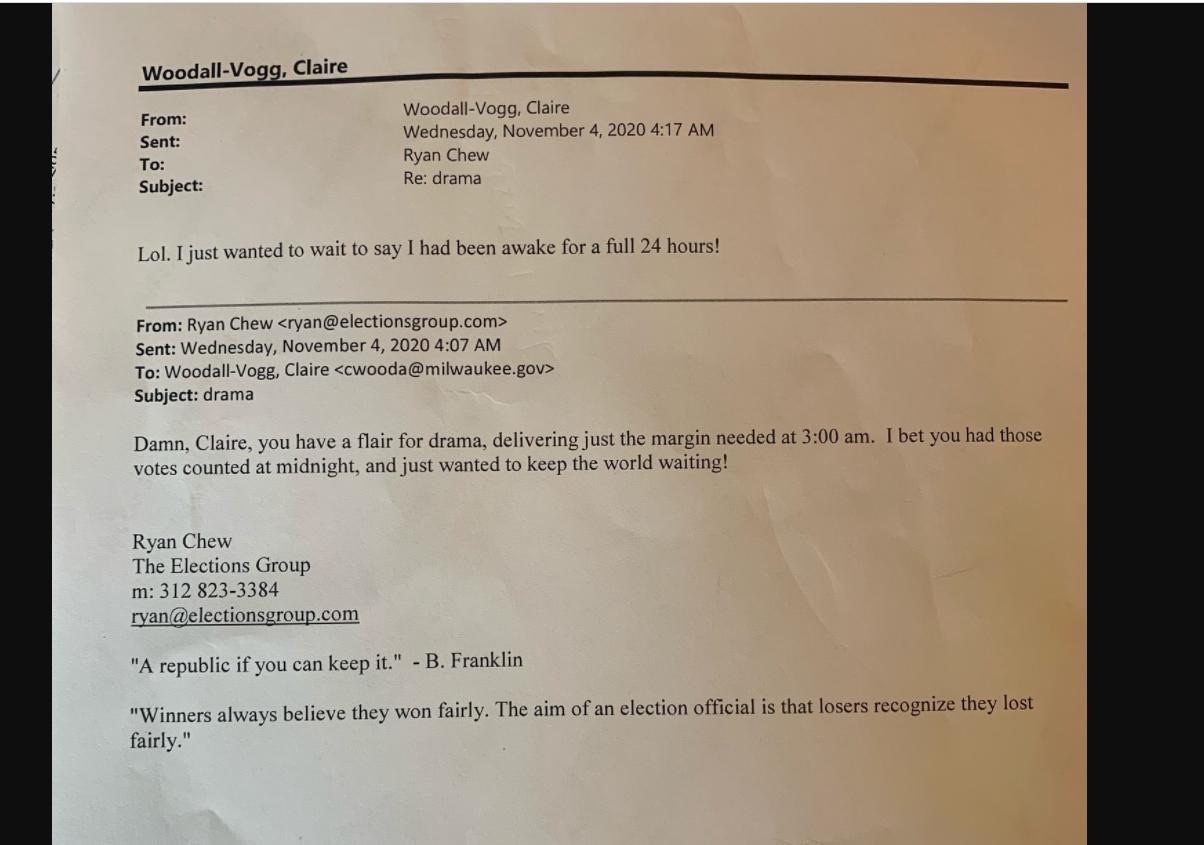
“Damn, Claire, you have a flair for drama,” Ryan Chew of the Elections Group wrote. The email was sent at 4:17 am on November 4, 2020, to the Executive Director of the Election Commission in Milwaukee, Wisconsin.
“…delivering just the margin needed at 3:00 am. I bet you had those votes counted at midnight, and just wanted to keep the world waiting!” he continued.
“Lol. I just wanted to wait and say I had been awake for a full 24 hours!” Vogg responded.
The Elections Group is a non-governmental organization that seems to have had its hands all over the 2020 election. From Ryan Macias’s involvement in Fulton County before and after the election, to the group’s founder, Jennifer Morrell, mixing it up at a backyard BBQ with Colorado election officials and election organizations, to Chew’s involvement in Wisconsin. Both Morrell and Macias also showed up during the Arizona audit back in 2021.
FBI Interviews Key Milwaukee Election Official
A report from the Milwaukee Journal Sentinel claims that an FBI agent has conducted an interview with “a high-ranking state election official” recently. Wisconsin Election Commission deputy administrator Robert Kehoe was the alleged official with whom the agent sat down.
According to the Milwaukee outlet:
How nearly 180,000 Milwaukee residents voted in the 2020 presidential election could be at risk of becoming public if the FBI compels election officials to hand over voting data here in its pursuit to relitigate Trump’s election loss in the key battleground states.
The ballots at issue are part of a swath of votes in liberal-leaning Dane and Milwaukee counties that Trump sought to throw out during a recount he paid for of Wisconsin’s 2020 presidential election, when the COVID-19 pandemic fueled a spike in absentee voting.
Wisconsin has a class of voters known as “indefinitely confined.” These are voters who are physically unable to leave their homes due to age, physical illness, infirmity, or disability. These voters automatically receive an absentee ballot without providing any copy of a valid photo ID.
The number surged for the 2020 election over normal historical trends. In 2016, there were around 60,000 such voters. By 2020, there were over 240,000.
Clerks in Madison and Milwaukee told their voters via social media that the COVID-19 emergency was a legitimate justification for making an “indefinitely confined” declaration.
“I have informed Dane County Municipal Clerks that during this emergency and based on the Governor’s Stay-at-Home order, I am declaring all Dane County voters may indicate as needed that they are indefinitely confined due to illness.”
A court later ruled that this was not the case and that Gov. Evers’ Stay at Home order did not make all voters eligible for “indefinitely confined” status.
The 2020 Election in Wisconsin
In the 2020 election, then-director of the Wisconsin Election Commission, Meagan Wolfe, declared unilaterally that ballot drop boxes would be used without a vote of the board of WEC commissioners. Nearly half of the mail-in ballots in Milwaukee were cast via drop box. It was promised that those drop boxes would be “under 24-hour surveillance”; however, not a single municipality in the county produced any video surveillance in response to open records requests.
In Green Bay, internal emails revealed that Michael Spitzer-Rubenstein of the National Vote at Home Institute was given four of the five keys to the KI Center ballroom, where ballots were stored and counted before the 2020 election by Green Bay Mayor Eric Genrich. He was also given access to a “hidden” internet network at the hotel’s convention center.
Trending: “Really Unattractive” Leftist Gets Clocked After Screaming at Trump at Rally – Trump Calls Supporter “Evander ‘The Real Deal’ Holyfield” – CROWD ROARS! (VIDEO)
Spitzer-Rubenstein also sought access to WisVote, which would give him access to absentee voter information, including which ballots had been returned already in real-time.
The access was reportedly in an effort to develop an app to track ballots being returned.
According to InfluenceWatch.org, in 2022, the Center for Renewing America filed a complaint with the IRS alleging that the Center for Tech and Civic Life violated 501(c)(3) rules by intervening in elections when it received $350 million from the Chan-Zuckerberg Initiative. The complaint also included the David Becker-founded Center for Election Innovation and Research, which received $69 million, and also included the National Vote at Home Institute.
The Green Bay clerk would ultimately resign over the handling of the 2020 election, citing “outside interference” and a “hostile work environment.”