
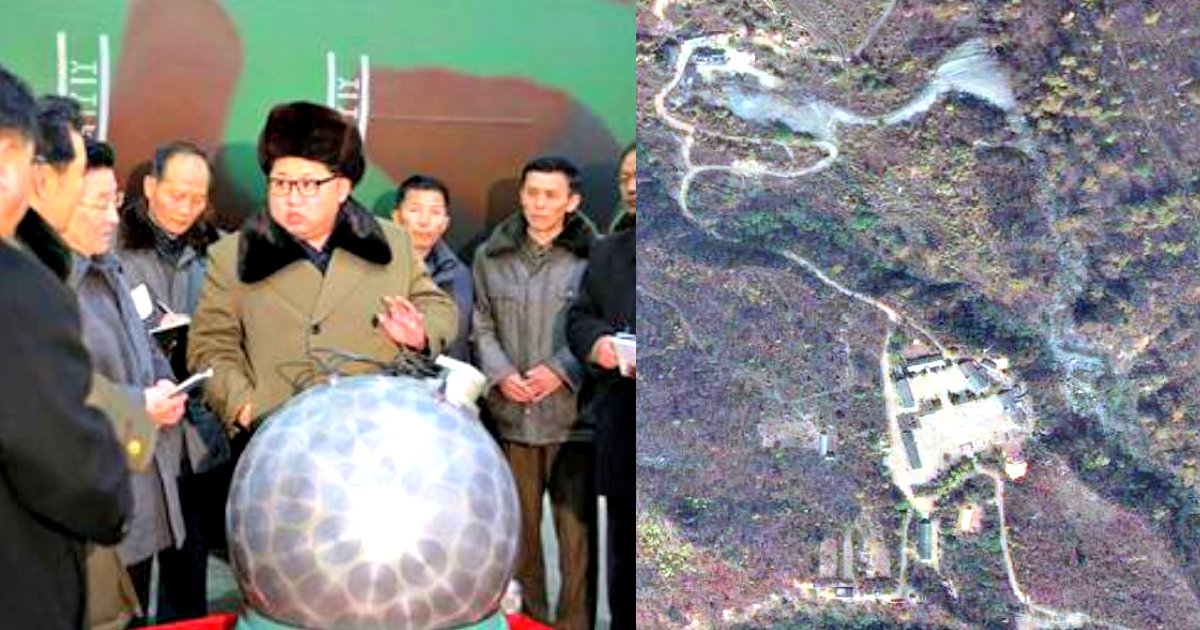
The planet is still reeling from North Korea’s Nuclear tests.
Between 2006 and 2017, North Korea carried out six underground nuclear tests in the Punggye-ri test site.
This may read like irrelevant facts from the past, but seismic data from 2008 to 2025 detected no less than 1,399 earthquakes around the mountain.
It is suspected that the underground explosions may have reactivated long-dormant faults, according to a new scientific study.
Yonhap: North Korea’s nuclear test may have triggered more than 1,300 earthquakes, report says.
— First Squawk (@FirstSquawk) September 18, 2026
The Korea Herald reported:
“An international research team led by Pusan National University Geological sciences Professor Kim Kwang-hee made the finding after analyzing 17 years of continuous seismic waveform data collected in South Korea and northeastern China between 2008 and May last year. The team included researchers from four Chinese institutions: Chengdu University of Technology, the Chinese Academy of Sciences, the China Earthquake Administration and Shandong University.
In the study, titled ‘Nuclear tests at Mt. Mantap have reactivated intraplate faults’, the researchers tracked changes in seismic activity around Mantapsan in Kilju, North Hamgyong Province, where the North conducted all six of its nuclear tests.”
It’s been almost 10 years since North Korea conducted an underground thermonuclear test at Mount Mantap. But new evidence shows how past blasts have critically damaged the geology of the site, turning it into an epicenter of seismic activityhttps://t.co/xajVJNz9uZ
— Scientific American (@sciam) September 17, 2026
No earthquakes were recorded in the area before North Korea’s first nuclear test in 2006.
“About 60 quakes were detected between then and the country’s sixth and most powerful test in September 2017. […] That pattern shifted dramatically after the 2017 test.
Seismic activity intensified about 20 days after the detonation and has continued ever since, with researchers detecting roughly 1,330 earthquakes. Most occurred along two fault zones that extend for about 24 kilometers in a north-northwesterly direction.”
North Korea’s underground nuclear tests at Mt. Mantap have had long-lasting and delayed effects on the region’s surrounding crust, according to a new Science study, triggering seismic activity that has persisted—and even intensified—for years after the detonations ended.
The… pic.twitter.com/cjOC09Y999
— Science Magazine (@ScienceMagazine) September 17, 2026
Even today, North Korea’s Mount Mantap continues to be rocked by earthquakes.
Scientific American reported:
“It’s been almost 10 years since North Korea last conducted an underground thermonuclear test at the mountain, which is also known as Mantapsan—yet the geology of the site appears to have been critically altered by intense explosions, according to a new study based in part on photographs taken in space.
‘Repeated underground nuclear tests [have] progressively disturbed and damaged the surrounding rock and changed the stresses acting on pre-existing faults’, says seismologist and geophysicist Kwang-Hee Kim of South Korea’s Pusan National University. The most recent nuclear test, in 2017, caused the most damage—and after some seismic faults on the mountain were disturbed, it started a domino effect, he says.”

“It’s normal for underground tests to spawn local earthquakes in the weeks that follow as the disturbed ground subsides. But an unusual earthquake on Mount Mantap a few minutes after the 2017 test raised experts’ concerns, and the new study reveals a fresh worry: ‘The phenomena they’ve identified and documented is a bit surprising’, says Columbia University seismologist Paul Richards, who wasn’t involved in the research. The situation is ‘potentially dangerous’, he says: ‘Will it lead to even bigger earthquakes?’’
Read more:

